The operation of a heat pump relies on a thermodynamic cycle, also known as a refrigeration cycle.
This cycle allows heat to be transferred from a colder area to a warmer area and vice versa.Therefore, it can effectively heat or cool.This device consists of several main components that work together in different stages.In short, these are as follows:
First, the operation of a heat pump begins with the evaporation stage.The liquid refrigerant in the evaporator absorbs heat from the environment.For an air source unit, it can absorb heat from the ambient air. Then, the refrigerant changes from a liquid state to a low-pressure, low-temperature gaseous state.
The compression stage begins when the compressor draws in the low-pressure, low-temperature gaseous refrigerant.
In this stage, the compressor uses a small amount of electricity to do work.It transforms the low-pressure, low-temperature gas into a high-pressure, high-temperature gas.
The next stage of heat pump operation is the condensation stage.In this stage, the heated, high-pressure, high-temperature gaseous refrigerant passes through the heat pump condenser.It transfers heat to the water through the heating circuit. The refrigerant will return to a liquid state.
Finally, the liquid refrigerant will flow through the expansion valve of the heat pump.The purpose is to reduce the pressure and temperature of the refrigerant.This continues until it evaporates into low-pressure, low-temperature wet vapor.This means the gas-liquid mixture will return to the evaporator.
Ultimately, the refrigerant will restart its thermodynamic or refrigeration cycle.
You can refer to a diagram of a heat pump to better understand its working principle.
The following diagram illustrates the cooling and heating cycles of the air source unit.
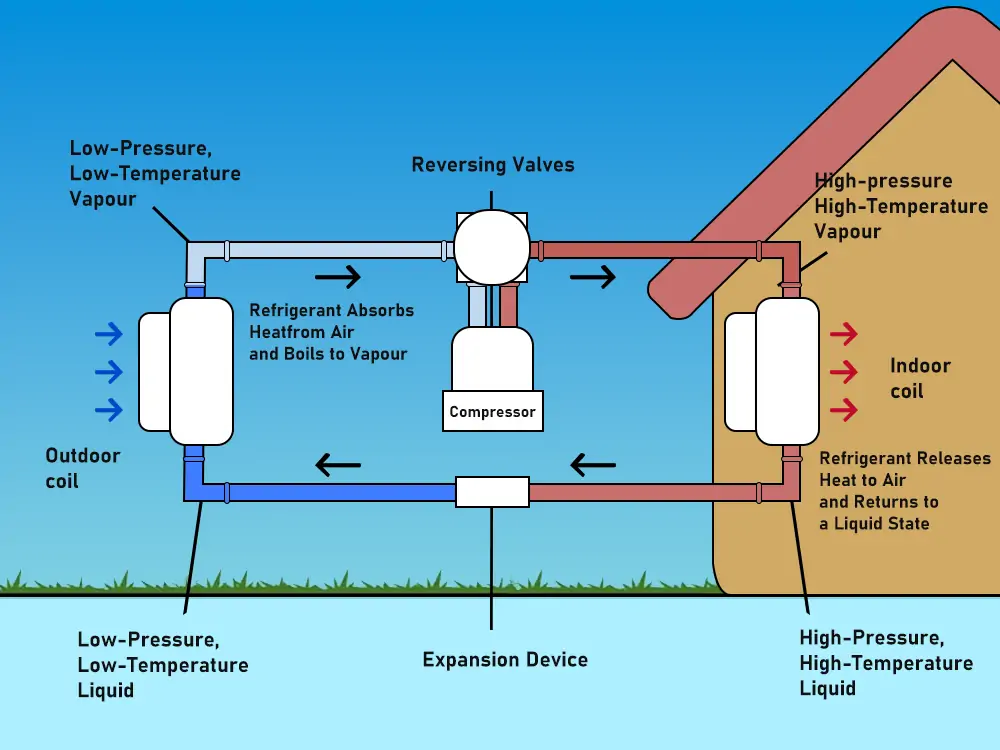
Here is a brief overview of the heating and cooling cycles of an air-source heat pump.As you can see, this type of device is sometimes referred to as an air-to-water heat pump.
In this cycle, the air drawn in by the outdoor unit transfers heat to the refrigerant.
After passing through the evaporator, the refrigerant turns into a gas and is then sent to the compressor.
This increases the pressure and temperature of the refrigerant due to the work done.The fully heated refrigerant transfers heat to the water in the condenser heating circuit.
Then, the refrigerant loses heat and becomes liquid again.
●Fan coils
●Underfloor heating
It provides hot water and space heating.
In the cooling cycle, the air-source heat pump reverses its heating cycle.Its purpose is to provide space cooling.Therefore, heat is transferred from inside the home and released into the ambient air outside.
The heat pump system extracts warmed air from the household into the indoor unit. You can see that this has an indoor coil. Then, the liquid refrigerant moves across the indoor coil. The hot air inside your household is absorbed into the refrigerant. Eventually, the refrigerant turns into a gas.
The gas then passes through the compressor from the reversing valve. Here, it’s temperature and pressure increase. It then shifts to the outdoor unit.
The outdoor unit then cools down the hot refrigerant as it moves through it. As a result, heat energy is released into the air. The refrigerant reverts into a liquid.
The refrigerant then moves from the outside unit to the inside one. Here, the expansion valve further cools it down. It then reverts to the indoor coil, and the cycle repeats.
Now, let’s briefly overview the workings of air-source heat pumps.
When the weather outside is cold, air-source units function in heating mode. They extract heat from the exterior air. As stated before, it moves through the following:
The motive is to provide space heating and hot water.
In warm weather conditions, an air-source unit functions in cooling mode, thus working oppositely.
The appliance absorbs heat energy from the air that’s inside your household. Owing to this, the refrigerant alters from a liquid to a gas. Then, it changes back to liquid and finally to a gaseous state. It’s accomplished through varied functions of the evaporator, compressor, condenser, and expansion valve.
Afterwards, it releases the heat into the external air to cool your household.
You can also refer to the heat pump schematic diagram. That can help you get an idea of how such appliances work.
You read about the workings of such appliances and observed their diagrams. Now, the following table glances at the differing heat pump types. Here we’ll shortly look at the advantages and disadvantages of each of them. We’ll also briefly look at the respective lifespan of each heat pump variant.
| Heat pump type | Advantage | Disadvantage | Typical lifespan |
| Air to water heat pump | ·Minimal maintenance requirements compared to other heating systems ·Year-round operation ·Many units offer cooling in addition to heating and hot water ·They are environmentally friendly and green heating/cooling solutions ·They are more energy-efficient, thus reducing energy costs | ·Higher initial costs than traditional heating systems like boilers ·Your home must be well insulated to minimize heat loss ·Radiators or underfloor heating may need to be replaced ·The outdoor unit of this heat pump will generate noise, which can be a concern ·Efficiency may decrease in frigid climates. | Maximum 20 years |
| Air-to-air heat pump | ·They are easy to install. ·They provide both heating and cooling. ·They are relatively affordable with lower installation costs. ·They are known for their high efficiency, with SCOP values ranging from 3.0 to 4.0. | ·They can remove dust from the air. ·Their efficiency decreases in cold climates. ·They can be noisy. ·These measures may be ineffective if your home is poorly insulated. | Maximum 20 years |
| Geothermal heat pump | ·Suitable for almost all climates ·They provide effective cooling/heating ·They are known for their exceptional energy efficiency (approximately 400%) ·They remain virtually silent ·They require low operating costs | ·They have higher initial installation costs. ·They may require significant landscaping modifications, leading to a disruptive installation process. ·Soil type affects efficiency. ·They may not be suitable for poorly insulated buildings. | Maximum 25 years |
| Water source heat pump | ·They are highly efficient due to their stable water temperature. ·They can provide both heating and cooling. ·They reduce operating costs. ·They are environmentally friendly. ·They have low maintenance costs. | ·Their initial cost is high. ·They need to be near a body of water, and supply is limited. ·Installing them may cause disturbance. ·Your home needs good insulation. | 15-20 years |
By now, you should understand the advantages and disadvantages of different heat pumps. You may have questions about them, or you may be interested in purchasing our products. You can contact us in either case.
 Add:8F, Xinghe Business Tower, 89 Jiefang Road, Hangzhou, Zhejiang, China




Copyright © 2026 Dentwiton. All rights reserved. 浙ICP备2025219677号