The concept of the screw compressor can be traced back to the early 20th century, when German engineer Heinrich Kriegar invented the first twin-screw compressor. However, it wasn't until the 1950s that the compressor was formally manufactured. The delay was due to insufficient technology and a lack of high-quality materials, making it impossible to realize the concept behind the compressor's structure.
In the 1960s,various companies began producing screw compressors for use in various industrial fields,including refrigeration and air conditioning.During this period,oil-injected screw compressors were manufactured.Using oil as a lubricant improved the compressor's efficiency and extended its service life.
Today, screw compressors are renowned for their reliability and efficiency, considered one of the most reliable types of HVAC compressors.
This is a common type of positive displacement compressor, which mechanically captures a fixed amount of air and reduces its volume to increase pressure, thereby providing a continuous and controlled airflow.
The convection compressor consists of two helical rotors (male and female) that are closely connected but not in contact with each other. During operation, the rotors rotate in opposite directions, compressing the air trapped between them. This compressor provides a stable and pulsating airflow.
Furthermore, screw compressors are highly regarded for their low maintenance requirements and reliability in environments requiring continuous airflow. They are typically available in two types: oil-filled and oil-free, thus providing a suitable option for sterile room applications such as the pharmaceutical industry.
The concept of the centrifugal compressor originated as early as 1689, a collaboration between French physicist Denis Papin and Dutch physicist Christian Huygens. They attempted to use an air compressor, leveraging centrifugal force to achieve compression.
Thanks to the deepening understanding of fluid dynamics and thermodynamics within the physics community, centrifugal compressor systems have evolved from rudimentary single-impeller blowers to the multi-stage systems used today.
With increasing emphasis on energy efficiency, centrifugal compressors, integrated with improved control systems, play a crucial role in energy-saving industrial processes.
This is a common type of dynamic compressor, which is a type of compressor that dynamically increases air compression by converting kinetic energy through high-speed impeller rotation.
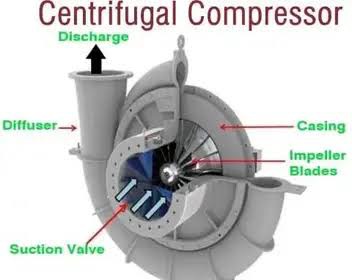
A centrifugal compressor is a mechanical device used to compress air using centrifugal force. It comprises several basic components that work together to efficiently compress air. At its core is the impeller, which transfers kinetic energy to the incoming air. The high-speed air then passes through a diffuser, where its kinetic energy is converted into potential energy due to increased pressure.
Centrifugal compressors are highly regarded for their suitability for applications requiring dynamic and variable airflow.Furthermore,these compressors are designed to be oil-free.The airflow path and oil system are designed as separate sections;a seal separates them.
Therefore, they are best suited for applications requiring pollution-free air, such as in the food and beverage, pharmaceutical, and manufacturing industries.
Although both centrifugal and screw compressors are used for large volumes of air, they operate on different principles.
The working principle of a centrifugal compressor begins with the rotation of an impeller, which is connected to the compressor shaft and is usually driven by an external drive unit such as an electric motor or a turbine.
Air is drawn into the compressor through the intake valve. As the impeller rotates, centrifugal force increases the amount of air drawn in, giving it kinetic energy.
Afterward, the high-speed air leaves the impeller and enters the diffuser, where kinetic energy is converted into potential energy, resulting in a significant increase in pressure.
Then, air flows out of the diffuser and into the fixed vortex housing, guiding the airflow to the outlet valve while maintaining pressure.
The working principle of a screw compressor is very simple. It involves the rotation of two meshing rotors. Another type of compressor with a similar working principle is the vortex compressor. This is why vortex compressors and screw compressors are often compared.
The rotors of a screw compressor are precisely designed and machined to mesh tightly. However, they do not contact each other; instead, they move in opposite directions.
As they begin to rotate, the compressor draws in air through the intake valve. As rotation continues, the rotors begin to narrow the space between them, causing the air to compress. The compressed air is then pushed to the midpoint of the rotor and discharged from the compressor through a discharge port connected to the end of the rotor.
In oil-filled screw compressors, oil is applied to the compression chamber as a lubricant for the moving parts. The oil not only lubricates but also prevents air from escaping from the compression chamber.
The structural design of screw and centrifugal compressors is a major factor influencing the differences between these two reliable compressor types.
Centrifugal compressors are complex in design, involving connections between key components. First, the impeller is directly connected to the shaft, which is guided by an intake valve, bearings, and seals to ensure stability and prevent air leakage. There is also an inlet that allows ambient air to enter, passing through the impeller to the diffuser, where kinetic energy is converted into potential energy. Finally, the diffuser connects to the outlet section that distributes the compressed air.
A screw compressor consists of two closely meshing screw rotors (male and female) that rotate in opposite directions. The rotors are enclosed in a cylindrical housing with inlets and outlets for air intake and exhaust. They also have other major components such as bearings and cooling jackets.
Screw compressors and centrifugal compressors can also be distinguished based on their advantages and disadvantages.
● Suitable for a wide range of applications and compression ratios
● Provides continuous and stable airflow
● Energy efficient and offers excellent load distribution performance
● Suitable for small industrial applications
● It requires more frequent maintenance than a centrifugal compressor.
● The effect of ultra-high speed operation is poor.
● Oil contamination issues when using an oil-filled screw compressor
● Ideal for high-speed and dynamic applications
● Capable of handling variable airflow
● Compared to screw compressors, it requires less maintenance.
● Suitable for larger industrial applications
● Complex design structure, containing numerous complex components
● High manufacturing costs
● Make it louder and vibrate
There are many factors that distinguish centrifugal compressors from screw compressors. Below, we will compare these two compressors to see their overall performance.
When comparing centrifugal and screw compressors using air quality as a parameter, it is essential to understand the solutions they serve.
Centrifugal compressors employ a segmented design because their structure contains many components, each with a unique function. The lubrication section differs from the compression section, which ensures the air remains uncontaminated. Generally, centrifugal compressors are known for their dynamic and high-speed operation, which ensures smoother compression and lower oil retention.
There are two types of screw compressors: oil-free and oil-injected. Oil-free compressors do not use oil lubricant, ensuring clean and uncontaminated compressed air. However, oil-injected compressors typically produce compressed air containing machine oil.
The efficiency of screw compressors and centrifugal compressors depends primarily on operating conditions.
Screw compressors are most energy efficient under partial load conditions, making them ideal for applications with fluctuating air demand, including cryogenic heat pumps. They are also highly reliable in handling start-stop cycles.
Centrifugal compressors are most energy-efficient when operating at full load, making them ideal for applications requiring constant, high-speed airflow. They are highly reliable in scenarios where air demand is stable and predictable.
As with any equipment, it is important to understand the cost differences between screw compressors and centrifugal compressors.
Screw compressors have a low initial cost due to their simple design and fewer parts. However, because their operating mechanism involves more moving parts, they require more frequent maintenance and repairs, resulting in higher operating costs.
When comparing rotary screw compressors and centrifugal compressors, one cannot ignore their size differences and their impact on their functionality.
Rotary screw compressors are simple and compact in design, making them highly practical for installations with limited space. Their size offers flexibility, ensuring easy adaptation to various space constraints. However, in high-capacity applications, screw compressors are not always the best choice because their design limits their performance.
Centrifugal compressors have a more complex design. Their scalability allows for increased capacity, making them ideal for applications with greater space requirements. Furthermore, centrifugal compressors are often used in larger-scale industrial applications due to their efficiency in handling larger volumes of air.
Both compressors demonstrated flexibility, but there are certain factors that can be used to differentiate between spiral and centrifugal chillers.
Spiral chillers are known for their robust design and, with proper maintenance, offer excellent stability and durability. Regular lubrication and inspections can also extend their lifespan.
Although centrifugal chillers operate at higher speeds, they have fewer moving parts. Furthermore, their wider external structure makes them more stable and durable than spiral chillers. Regular maintenance, such as vibration monitoring and balancing, helps improve their stability and lifespan.
Spiral coolers and centrifugal coolers differ significantly in capacity because they meet different industrial needs.
Spiral coolers offer a wider range of capacities. They can be used in applications with various compression ratios. Their design supports high performance under diverse load conditions, making them a better choice for handling fluctuating air demands.
On the other hand, centrifugal chillers are specifically designed for large-scale industrial applications due to their ability to efficiently handle large volumes of air.
Noise and vibration levels are important factors to consider when evaluating the comfort of using screw and centrifugal compressors.
Screw compressors, due to their compact design and more moving parts, produce more noise and vibration. Furthermore, the positive displacement mechanism of these compressors amplifies the noise, especially during start-up and shutdown.
Centrifugal compressors, due to their dynamic and high-speed operating mechanism, produce less noise and vibration. These compressors operate more smoothly and in a quieter environment.
Maintenance and repair play a crucial role in determining the superiority of spiral coolers over centrifugal coolers and how their overall performance is affected.
Spiral chillers require more frequent maintenance and repair due to their positive displacement mechanism. Secondly, their operating system contains more moving parts, which generates friction and eventually leads to wear over time. However, this can be reduced through regular lubrication and inspection.
On the other hand, the working system of a centrifugal chiller involves fewer moving parts, so it requires less maintenance and repair.
The difference between rotary screw compressors and centrifugal compressors can also be categorized according to their applications. Both types of compressors perform excellently in multiple industries.
Rotary screw compressors are versatile and suitable for a variety of applications, making them the preferred choice for diverse compression needs. They are most efficient under variable loads and start-stop cycle requirements.
Centrifugal compressors are best suited for large industrial applications, especially those requiring constant high-speed airflow. Their dynamic operation and scalability make them ideal for high-capacity, high-efficiency, and demanding applications.
Now that we've discussed the differences between centrifugal and screw compressors, it's time to choose which one best suits your needs.
Overall, screw compressors are best suited for a variety of applications, including variable load and start-stop cycles. Centrifugal compressors are best suited for large industrial applications requiring high-speed compression ratios and dynamic operation.
Furthermore, screw compressors have a simple design and low initial cost. However, due to the many moving parts involved in their operation, they require more maintenance and repair, leading to increased operating costs. Additionally, the numerous moving parts generate higher noise and vibration levels.
Centrifugal compressors are more complex in design and have higher initial costs. However, their operating mechanism has fewer moving parts, resulting in lower maintenance and repair costs, thus reducing operating costs. They also produce less noise due to the fewer moving parts.
Dentwiton is one of the world's leading and reliable manufacturers of air-to-water heat pumps. We possess the expertise and knowledge to select the best type of HVAC compressor, as the compressor directly impacts the performance of HVAC systems. If you are looking for the best professionals in heat pumps or air conditioning compressors, please feel free to contact us.
 Add:8F, Xinghe Business Tower, 89 Jiefang Road, Hangzhou, Zhejiang, China




Copyright © 2026 Dentwiton. All rights reserved. 浙ICP备2025219677号